

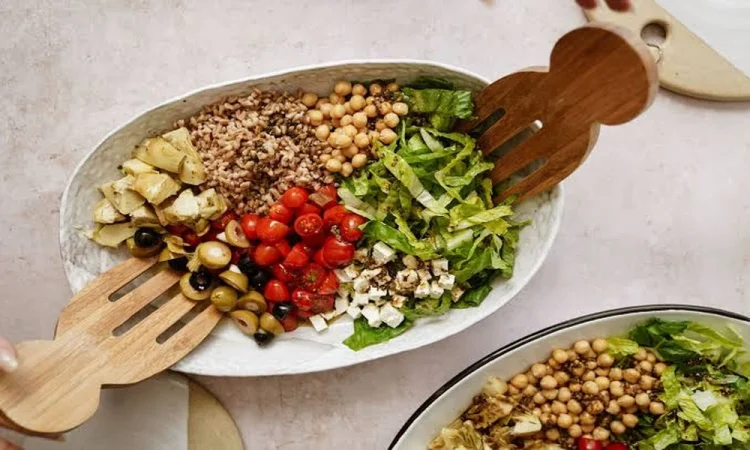

What Fills the Bowl: Grains, Greens, and Everything Between
Grain bowls and salads have split into so many subcategories that the terms barely describe one kind of meal anymore. Some versions lean heavily on warm grains like farro, bulgur, or rice pilaf as a base, while others skip grains entirely and build around layers of greens, shredded vegetables, and legumes. The protein choices vary just as widely, ranging from grilled chicken and falafel to seared fish or marinated lamb, depending on the kitchen’s influences. Sauces and dressings often end up being the real differentiator, since a bowl dressed in a bright lemon-herb vinaigrette eats completely differently than one finished with a thick tahini or a garlicky yogurt sauce.
Regional traditions shape these bowls more than most people realize. A Greek-leaning version might favor cucumber, tomato, olives, and feta with oregano-forward seasoning, while a Levantine approach brings in sumac, pickled turnips, or a scoop of hummus folded into the mix. Some restaurants build bowls around a single dominant flavor, like a roasted eggplant and pomegranate molasses combination, while others aim for balance across six or seven smaller components. None of these approaches is inherently better, but they do produce very different eating experiences, and that variation is exactly what makes comparing them worthwhile before settling on a regular order.
Portion structure also plays a bigger role than people tend to notice when they’re scanning a menu quickly. A bowl that piles everything into one undifferentiated mass tends to lose the character of each ingredient, while one assembled in distinct sections lets the grain, vegetables, and protein each hold their own texture until the first bite mixes them together. That difference shows up most clearly with anything involving crisp elements like pickled onion or toasted nuts, which lose their appeal fast once buried under a heavy sauce. Paying attention to how a bowl is physically built, not just what’s listed in it, often predicts how satisfying the meal will actually be.
Reading a Menu Description Without Getting Misled
Menu language can make almost anything sound appealing, so it helps to look past adjectives and focus on structure. A good place to start is identifying the ratio of vegetables to starch to protein, since a bowl that leans too heavily on rice or pasta salad filler will feel heavier and less satisfying than one built around a wider mix of produce. Spitz approaches this by offering Mediterranean bowls and salads that combine grilled proteins with fresh vegetables and house-made sauces rather than relying on a single starch to carry the dish. That kind of composition tends to hold up better, both in flavor and in how the meal sits afterward.
Dressing and sauce proportions deserve attention too, since an otherwise well-built bowl can be undone by sauce that’s either too sparse or heavy-handed. It also matters whether vegetables are raw, roasted, or pickled, because that affects texture as much as flavor. A bowl with only raw components can feel one-note, while one that mixes roasted peppers, pickled onions, and fresh herbs tends to have more going on in each bite. Reading beyond the ingredient list to understand how components are prepared gives a much clearer sense of what’s actually arriving at the table.
Portion size claims are worth a second look as well, since
large
and
generous
mean different things depending on how a kitchen fills a bowl. A description promising abundance might just mean more lettuce rather than more protein or vegetables, which changes the value proposition considerably. Asking about or noticing the balance of components, rather than trusting the overall size alone, tends to be a better predictor of whether a dish will feel substantial once it’s actually in front of you.
Matching the Bowl to the Moment You’re Eating It In
Context changes what counts as a good choice far more than most diners account for. A bowl ordered for a quick weekday lunch needs to be satisfying without leaving someone sluggish for an afternoon of work, which usually means favoring lighter grains, lean proteins, and dressings that don’t sit heavy. A dinner order, on the other hand, can afford to be richer, with denser grains, roasted vegetables, and a more generous hand with sauce, since there’s no need to stay sharp for the next few hours. Thinking about timing before scanning the menu narrows the decision considerably and avoids the common mistake of ordering something that looks appealing but doesn’t fit the moment.
Personal dietary patterns matter as well, particularly for anyone tracking protein intake or trying to limit refined carbohydrates. Bowls built around legumes, grilled meats, and a vegetable-forward base tend to fit a wider range of goals than ones centered on pasta salads or heavily dressed grain mixes. It also helps to think about leftovers, since some combinations hold up well in the refrigerator while others turn soggy within a few hours. A bowl with components kept separate, or dressing added just before serving, travels and reheats far better than a fully mixed salad. Taking a few seconds to weigh these practical factors, rather than ordering on appearance alone, tends to produce meals people actually look forward to finishing.